
How to Apply for Government Jobs in South Africa: 2026 Guide
Knowing how to apply for government jobs in South Africa is mostly about getting a set process right. Small mistakes, like an old form or a missing reference number, stop good applications before anyone reads them.
This guide takes you from finding a real vacancy to what happens after the closing date. It’s written for first-time applicants, graduates and anyone who’s applied before without hearing back. Each section links to a more detailed guide when you need one.
Government Jobs is an independent guide, not a government department. We don’t process applications. Always apply through the channel named in the official advert.
What counts as a government job in South Africa
“Government job” covers several kinds of employer, and each one recruits differently:
Employer | Examples | Where posts are advertised | Application form |
|---|---|---|---|
National and provincial departments | Home Affairs, Health, Correctional Services, each province’s departments | The weekly Public Service Vacancy Circular and department websites | The Z83 (2021 version) |
Municipalities | Metros, district and local municipalities | Municipal websites and local media | Often their own form. Check the advert. |
State-owned entities and agencies | South African National Roads Agency (SANRAL), Transnet, South African Broadcasting Corporation (SABC) | Their own careers pages | Usually their own process, not the Z83 |
Internships, learnerships and graduate programmes | Run by departments, municipalities, Sector Education and Training Authorities (SETAs) and entities | Wherever the organisation advertises | Depends on the programme |
Most of this guide covers national and provincial department posts, because they share one standard process under the Public Service Act. If you’re applying to a municipality or an entity, follow the instructions in that advert.
How it differs from private-sector hiring: the form is prescribed, the advert’s requirements are applied strictly, a panel does the selection and communication is limited. Many applicants never get a rejection notice.
Minimum requirements to apply
There’s no single set of requirements for all government jobs. Each advert lists its own, and those are the ones that count. Most include some mix of the following:
- Qualifications. From basic literacy or Grade 10 for some general-worker posts, to Grade 12 (matric) for most entry-level admin posts, to a diploma, degree or professional qualification for specialist and management posts.
- Experience. Stated in years and often in a specific field. Many entry-level posts need none.
- Citizenship. Many posts need South African citizenship. Some accept permanent residents. The advert will say.
- Professional registration where the profession requires it, for example with the South African Nursing Council (SANC), the South African Council for Educators (SACE), the South African Council for Social Service Professions (SACSSP) or the Engineering Council of South Africa (ECSA).
- A driver’s licence where the advert lists one.
- Disclosures. The Z83 asks about criminal records, previous dismissals from the public service and business interests with the state. A record doesn’t automatically rule you out of every post, but you must answer honestly.
Read the “Requirements” section of the advert line by line. If you don’t meet a listed requirement, your application will very likely be screened out. Items described as “an added advantage” or “recommendations” are different: you can still apply without them.
Read our Government Job Requirements guide
Where to find government vacancies in South Africa
Every week except December, the Department of Public Service and Administration (DPSA) publishes the Public Service Vacancy Circular. It lists vacancies across national departments and provincial administrations, but it comes as one long PDF. Circular 16 of 2026 ran to about 280 pages. That’s hard to search and even harder to read on a phone.
That’s why we built www.southafricangovernmentjobs.org.za. We list government vacancies as individual posts you can search and open on your phone, and you can set up a free job alert so new vacancies come to you instead of you scrolling through PDFs every week.
The official advert is still the source of truth. Before you apply, open the original and check the reference number, closing date and submission instructions there. Official sources include:
- The Public Service Vacancy Circular on the DPSA website (www.dpsa.gov.za).
- Department websites, most of which have a careers or vacancies page.
- Provincial e-recruitment systems, where a province or department uses one.
- Municipal websites for municipal posts.
- Entity careers pages for state-owned entities and agencies.
Browse all open government vacancies
Set up Job Alerts Here
What a fake vacancy looks like
- It asks for money: an “application fee”, “verification fee”, “processing fee” or a payment to secure an interview.
- The website or email address doesn’t end in gov.za, or is a close copy of a real department’s address.
- The post doesn’t appear in the DPSA circular or on the department’s own website.
- The only contact is a WhatsApp number or a personal email address.
- It promises a guaranteed job, or lists a large number of posts with no reference numbers.
Government departments don’t charge you to apply. Any request for a fee is a scam. |
Step by step: how to apply for government jobs in South Africa
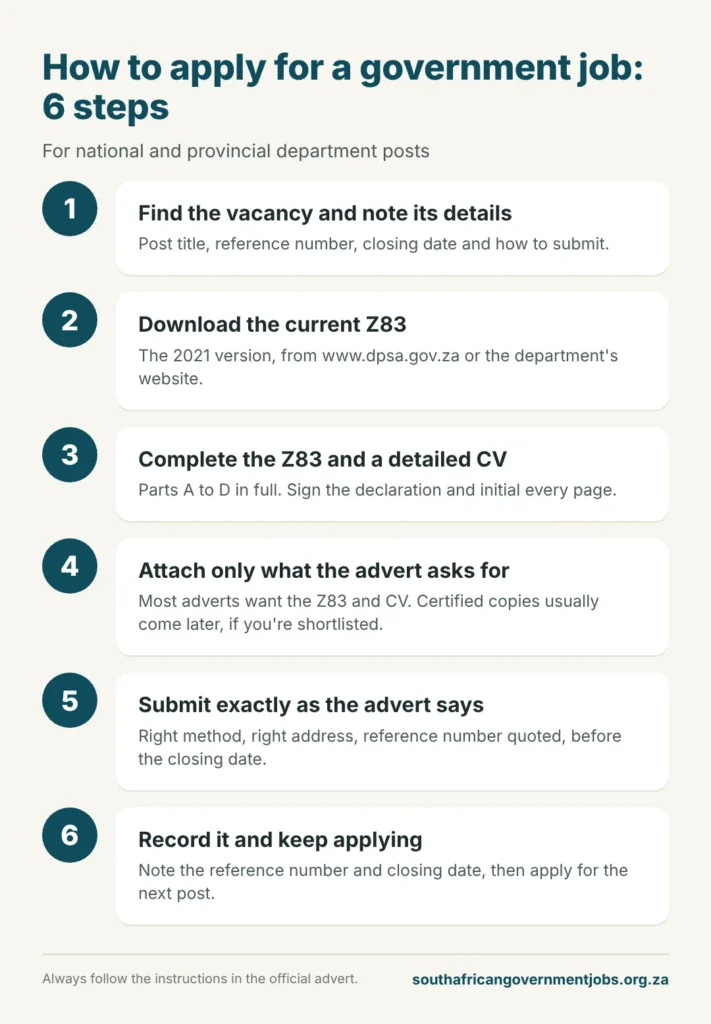
- Find the vacancy and write down its details. Note the exact post title, reference number, department, closing date and submission method. You’ll need each of these on the form and in your submission.
- Download the current Z83. Vacancy circulars tell applicants to use the new Z83, effective from 1 January 2021, and departments reject applications on the old form. Download it from www.dpsa.gov.za or the department’s own website, not from a copy someone forwarded you.
- Complete the Z83 and prepare your CV. Fill in every section that applies to you and write “N/A” where a field doesn’t apply, rather than leaving it blank. Sign the declaration. Then prepare a detailed CV with your positions, dates and main responsibilities. The dates, job titles and qualifications must match your Z83.
- Attach only what the advert asks for. In May 2022 the DPSA said applicants don’t need to submit certified copies when they apply. Most adverts now ask for a completed Z83 and a detailed CV only, and request certified copies from shortlisted candidates on or before the interview day. If an advert asks for certified copies upfront, provide them.
- Submit exactly as the advert instructs. Use the method it names: email, hand delivery, post or an online system. For email, many departments want your Z83 and CV combined into one PDF, with the job title and reference number in the subject line. Some reject photos (JPEG) or zipped files. Make sure your application arrives on or before the closing date, not just that you sent it.
- Record your application and keep applying. Note the post, reference number, closing date and the date you applied. Then apply for other posts you qualify for. Waiting on one application is the slowest way to get a government job.
How to fill in the Z83 (summary)
The Z83 is the standard application form for posts under the Public Service Act. These rules prevent most problems:
- Complete Sections A to D in full. Several departments accept “refer to CV” in Sections E, F and G because space is limited, but you must still answer the Part F question about conditions that prevent re-appointment. If you already work in the public service, write “N/A”.
- Match your ID exactly. Your name, ID number and date of birth must match your ID document.
- Use one Z83 per post. The post title and reference number must match the advert. If you list two posts on one form, a department may only consider the first.
- Answer the disclosure questions honestly.
- Initial and sign the form. An unsigned Z83 can get your application disqualified.
- Type it if your handwriting isn’t clear. The DPSA offers an editable version of the form.
How to Fill Out a Z83 Form, the full section-by-section guide
Common reasons applications are screened out
- Using the old Z83, or leaving the declaration unsigned.
- Blank fields in Sections A to D.
- A wrong or missing reference number.
- Not meeting a listed requirement, such as a qualification, years of experience, registration or licence.
- Details on the Z83 that don’t match your CV or ID.
- Sending photos or zipped files when the advert asks for a PDF.
- Submitting to the wrong address, in the wrong way, or after the closing date.
What happens after you apply
There’s no fixed national timeline. The stages are broadly the same across departments, but how long each takes depends on the number of applications, panel availability and approvals:
- Screening. HR checks each application against the advert and removes incomplete ones.
- Shortlisting. A selection panel scores the remaining applications and chooses who to interview.
- Interviews and assessments. Shortlisted candidates are invited and told what to bring, including certified copies. Many departments also run a practical exercise and an integrity (ethical conduct) assessment.
- Checks and approval. Qualifications, citizenship, criminal record and employment history are verified, and the appointment is approved before an offer is made.
Most departments only contact shortlisted candidates. The waiting period before you should assume you were unsuccessful varies by advert. In Circular 16 of 2026, most departments said three months after the closing date, one said eight weeks and another said six months. Check the note in your advert.
Entry-level government jobs you can apply for
If you’re starting out, look for posts whose requirements you can meet today. General workers, cleaners, admin clerks, data capturers, registry clerks and receptionists appear in circulars regularly, along with internships and learnerships. Some real examples from Circular 16 of 2026:
Post | Department | Salary | Requirements |
|---|---|---|---|
Registry Clerk | Communications and Digital Technologies | R237,453 per year (Level 5) | Grade 12, no experience needed |
Scanning Operator | Cooperative Governance | R170,226 per year (Level 3) | Grade 12, no experience needed, MS Word and Excel |
Handyman and Household Aid | Agriculture | R144,024 per year (Level 2) | See the advert |
These posts have closed, but similar ones appear every week. Salaries and requirements differ by post, so check each advert.
Frequently asked questions
Do I have to pay to apply for a government job?
No. Government departments don’t charge application, processing or verification fees. Treat any request for payment as a scam.
Do I need certified copies when I apply?
Usually not. Since the DPSA’s 2022 guidance, most departments ask for certified copies only from shortlisted candidates. If an advert asks for them upfront, follow the advert.
Can I use one Z83 for several posts?
No. Complete a separate Z83 for each post, with that post’s reference number.
How long until I hear back?
It varies. Most adverts say to accept that you were unsuccessful if you haven’t been contacted within three months of the closing date, but some give eight weeks or six months.
Will I be told if I was unsuccessful?
Often not. Departments usually contact shortlisted candidates only.
Can I follow up on my application?
Yes, politely, using the enquiries contact in the advert. Questions go to the advertising department, not the DPSA. Wait a few weeks after the closing date first.
Does a criminal record disqualify me?
Not automatically for every post, but shortlisted candidates go through criminal record checks and some posts, especially in security and justice, are strict. Disclose it honestly on the Z83.
What if I studied outside South Africa?
You’ll usually need an evaluation of your foreign qualification from the South African Qualifications Authority (SAQA), at your own cost. Apply early, because it takes time
Is Government Jobs a government website?
No. Government Jobs is an independent guide that helps you find and understand government vacancies. Applications always go to the department named in the advert.
Next steps
Start with the advert: check you meet the requirements, note the reference number and closing date, and follow the submission instructions exactly. Then use the detailed guides for each stage:
- How to Fill Out a Z83 Form
- Government Job Requirements
- Government Job Interview Guide
- Government Salary Levels
- Government Hiring Timeline
- [LINK: Free Government Job Application Checklist]
Ready to apply? Browse open government vacancies on www.southafricangovernmentjobs.org.za and set up a free job alert so you never miss a closing date. [LINK: listings page] [LINK: job alert sign-up]
Sources
- DPSA, Public Service Vacancy Circular 16 of 2026 (15 May 2026): weekly publication except December; enquiries to the advertising department; new Z83 effective 1 January 2021; Z83 completion, email submission and certified copy notes; response periods; entry-level salary examples.
- DPSA, Public Service Vacancy Circular 31 of 2026 (28 August 2026).
- DPSA statement on certifying copies for government employment (6 May 2022).
- Department of Public Works and Infrastructure job scam warning (2 October 2023).

Bussi Khumalo is a professional recruiter specializing in government sector employment in South Africa.
Bussi helps connect qualified candidates with meaningful public sector careers while contributing to broader conversations about fair remuneration and workforce development in government institutions.
With a BCom degree and currently pursuing her Master’s degree, Bussi’s academic research focuses on compensation levels within the South African public sector—a critical area that bridges human resources practice with economic policy. Her expertise in government recruitment gives her unique insights into public sector employment trends, hiring practices, and the complexities of compensation structures across various government departments and agencies.
Through her work, Bussi helps connect qualified candidates with meaningful public sector careers while contributing to broader conversations about fair remuneration and workforce development in government institutions.
Her dual role as both a practicing recruiter and academic researcher positions her as a knowledgeable voice on public sector human capital management in South Africa.